Two salespeople each expense a $100 lunch. One lunch leads to a $500,000 deal. The other leads to three follow-up emails that start with "Just checking in."
Accounting files both under Meals & Entertainment.
Recently, our CEO, Tom Parker used this example during a conversation with a client who wanted to understand what their AI agent would cost to operate at scale. It was a fair question. We could estimate the cost of building the solution and forecast ongoing consumption. But what we couldn't tell them with absolute certainty was exactly how many tokens the agent would consume once it started handling real-world requests.
And that's where the conversation got interesting.
Why AI Token Costs Aren't Always Predictable
Most large language models, including Claude and ChatGPT's underlying models, use tokens to measure consumption. Think of tokens as units of information the model reads and generates. Here's what makes it complicated: not every word uses the same number of tokens, and not every request requires the same amount of work.
Imagine an AI customer service agent. One customer asks, "What's your return policy?" The agent retrieves the policy and responds. Simple.
Another asks, "Can I return something I purchased six months ago?" Now the agent might need to retrieve purchase history, review the return policy, check exceptions, and make multiple model calls before responding.
Both customers asked a question. But the amount of processing, and therefore the cost, could be very different. The price per token is generally known. The number of tokens required to complete each task is where the variability comes in. That doesn't mean costs can't be forecast. It means forecasts need to be tested against actual usage.
Give Your AI Agent an Expense Account
Think back to those two sales lunches. We don't stop salespeople from entertaining clients because we can't predict which lunch will generate revenue. We establish budgets, set expectations, and measure results. Over time, we learn which activities generate value and adjust spending accordingly.
Why wouldn't we manage AI consumption the same way?
Let's say we deploy an AI agent and run 500 real customer requests through it. After testing, we find that the average request consumes $0.12 in tokens, while the most expensive 10% cost $0.30 or more. At 10,000 requests per month, our initial consumption forecast is approximately $1,200.
We might establish a $2,000 monthly budget, implement alerts as spending approaches that threshold, and monitor which requests consume the most resources.
Then we calibrate. Maybe the agent is retrieving five years of customer history when it only needs the most recent transaction. Maybe it's using a sophisticated model for tasks a smaller model could handle just as effectively. Those are opportunities to optimize.
And just like a salesperson's expense account, the budget should evolve based on the value being generated. The objective isn't to eliminate variable spending. It's to make sure that spending is justified.
The Cheapest AI Agent Might Be Your Most Expensive
Here's where I think organizations can get AI economics wrong. We become so focused on reducing token consumption that we lose sight of what the technology is supposed to accomplish.
Consider two AI agents handling 100 customer support requests. Agent A costs $0.05 per request but requires a human to finish 75 of them. Agent B costs $0.50 per request but only requires human intervention on 10. Assume each human handoff costs $6 in employee time.
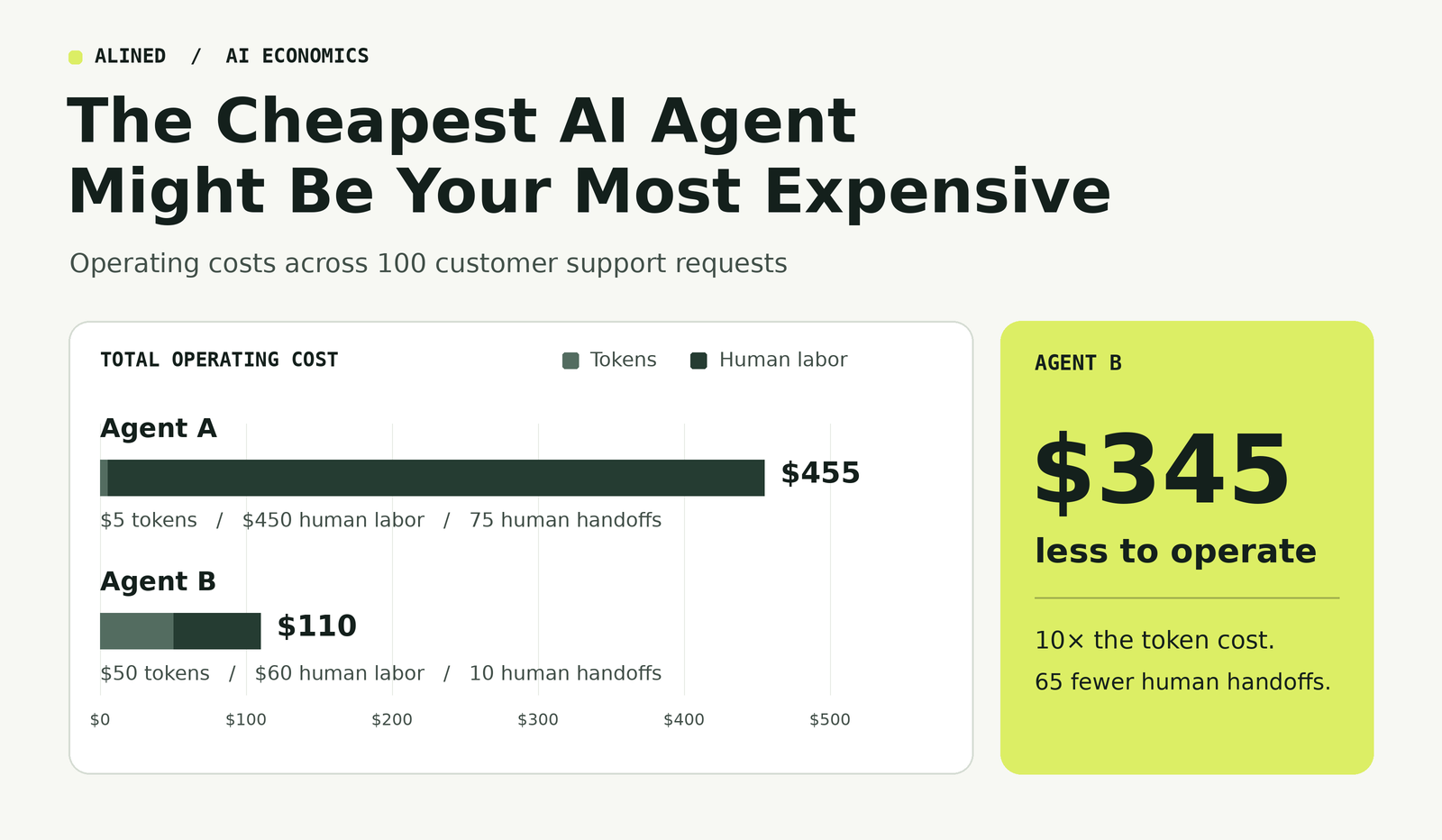
Illustrative example; assumes comparable resolution quality and excludes other operating expenses.
Agent B consumes ten times more in tokens but costs $345 less to operate across those 100 requests. If we evaluated these agents solely on token consumption, we'd make the wrong decision.
The goal isn't to minimize the cost of an AI interaction. It's to minimize the cost of achieving a successful business outcome. That's a very different conversation.
Measure What Matters, Then Calibrate
This isn't an argument for unlimited AI spending or building solutions without a business case. An AI build should have a clear financial justification before significant investment. Development, integration, security, and maintenance all matter.
But once an AI solution is deployed, managing consumption requires a different approach. Establish a budget. Monitor usage. Understand which requests drive costs. Measure accuracy, successful completions, and human intervention.
Then adjust. If an agent is consistently delivering strong business value, higher token consumption might be completely justified. If it's consuming resources without producing meaningful outcomes, optimize it or reconsider the workflow.
Because ultimately, the goal isn't to consume fewer tokens. It's to generate more business value from the tokens you consume.
Otherwise, we're just getting really good at tracking lunch.
At Alined Consulting Group, this is how we believe organizations should approach AI: with financial discipline, practical guardrails, and a focus on outcomes rather than activity.
As a Launch Select Tier Partner in the Claude Partner Network, we're helping organizations move beyond AI experimentation into production-ready workflows and agents. And the economics of operating those solutions matter just as much as the technology behind them.